Starting out with invoicing feels deceptively simple — until the first payment is late, a client disputes a line item, or tax season arrives and your records are in chaos. Most beginners don’t struggle because invoicing is technically hard. They struggle because no one explained the full picture: what an invoice actually is, what it must contain legally and practically, how the end-to-end process works, and what separates a professional invoice from one that gets ignored.
This guide fixes that. It’s designed to be the only resource you need — a complete walkthrough of invoicing essentials, from the absolute fundamentals to modern regulatory requirements, jurisdiction-specific rules, international invoicing, habits, tools, and edge cases that trip up even experienced freelancers and small business owners. Whether you’re sending your first invoice this week or trying to systematize a process that’s grown messy, everything you need is laid out below.
What Are Invoicing Essentials?
An invoice is a formal document issued by a seller to a buyer that itemizes a transaction and requests payment. It’s not just a receipt, a bill, or a quote — it’s a legally significant record that serves four distinct purposes:
- A payment request — telling the client exactly what they owe and when
- A legal document — proof of the transaction for both parties and tax authorities
- An accounting record — feeding directly into bookkeeping, VAT reporting, and financial statements
- A communication tool — confirming deliverables, terms, and expectations
Invoicing essentials are the non-negotiable elements and practices that make an invoice functional, professional, and legally compliant. Miss them, and you risk delayed payments, disputes, rejected tax claims, or worse — fines for non-compliance in regions with strict invoicing regulations.
For a business, invoicing is the bridge between delivering value and receiving money. Poor invoicing isn’t a minor administrative flaw — it directly damages cash flow, client relationships, and your ability to plan financially. Mastering the fundamentals is one of the highest-leverage skills any beginner can develop.
Anatomy of an Invoice
Before diving into components one by one, it helps to see them all at once. The infographic below maps every element of a complete invoice to its purpose — a visual reference you can return to any time you’re building or reviewing one.
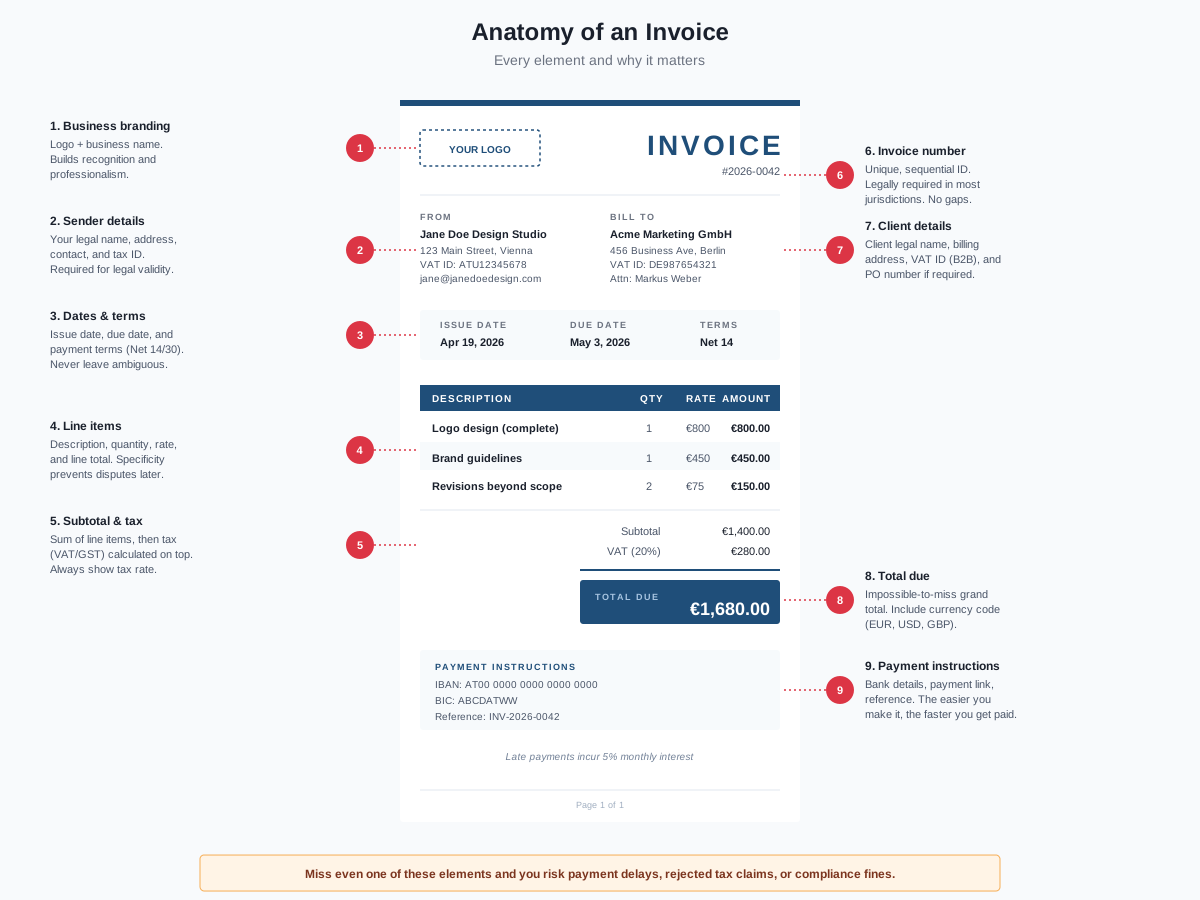
Every numbered element serves a specific legal, practical, or communication purpose. The sections that follow break down each one in detail.
Core Components of an Invoice
Every complete invoice contains the same structural building blocks. Learning these is the foundation of everything else.
Business Information (Your Details)
The top of the invoice identifies you — the sender. Include:
- Legal business name (and trading name if different)
- Business address
- Contact email and phone number
- Tax identification number (VAT ID, EIN, ABN, etc., depending on your country)
- Company registration number if applicable
- Logo, if you want visual branding
Client Information
Directly below or beside your details, identify the recipient clearly:
- Client’s full legal name or registered business name
- Billing address (this may differ from their operating address)
- Client tax ID if required in your jurisdiction
- Name of the specific contact responsible for payment
- Purchase order (PO) number if the client requires one
Invoice Number
Every invoice needs a unique, sequential identifier. This isn’t optional — in most jurisdictions, it’s a legal requirement, and for practical purposes, it’s how you and your client track and reference payments.
Common numbering systems:
- Sequential: 0001, 0002, 0003…
- Date-based: 2026-04-001, 2026-04-002…
- Client-coded: ACME-001, ACME-002…
Pick one system and stick to it. Never reuse numbers or leave gaps.
Invoice Date and Due Date
Two dates matter:
- Issue date — when you created and sent the invoice
- Due date — when payment is expected
Never leave the due date vague. “Upon receipt” is legally ambiguous in many regions. Use specific terms like Net 7, Net 14, Net 30, or an exact calendar date.
Itemized List (Line Items)
The heart of the invoice. Each line should show:
- Description — what was delivered, written clearly (not “consulting services” but “Website audit and recommendations, March 2026”)
- Quantity — units, hours, or deliverables
- Unit rate — the price per unit
- Line total — quantity × rate
Specificity prevents disputes. If a client later questions a charge, a clear description saves you from digging through emails.
Pricing, Taxes, and Discounts
Below the line items:
- Subtotal — sum of all line totals before tax
- Discounts — applied before or after tax, clearly labeled
- Tax — VAT, GST, sales tax, or similar, with the rate shown (e.g., “VAT 20% — €280.00”)
- Other charges — shipping, handling, expenses, if applicable
Total Amount Due
The final, bolded, impossible-to-miss number. Include the currency symbol and currency code (e.g., “€1,680.00 EUR”) to avoid confusion on international invoices.
Payment Terms
This section tells the client how and when to pay:
- Accepted payment methods (bank transfer, card, PayPal, Stripe, etc.)
- Bank account details or payment link
- Due date (restated for clarity)
- Late payment penalties or interest, if applicable
- Reference to include with payment (usually the invoice number)
How the Invoicing Process Works (End-to-End)
Invoicing isn’t a single action — it’s a lifecycle. Understanding all seven stages prevents the “I sent it, now what?” confusion that plagues beginners.
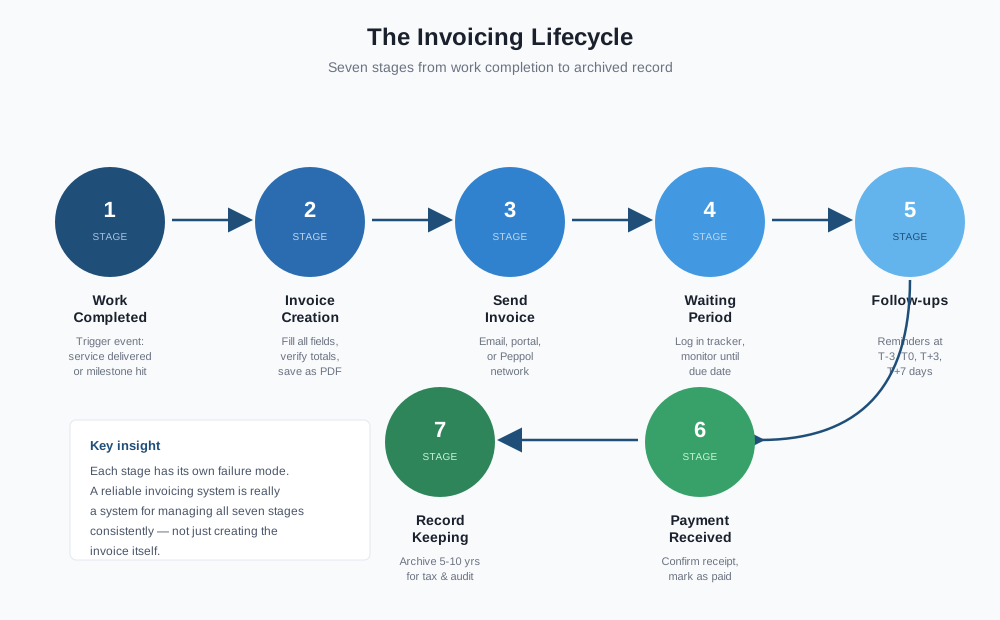
Stage 1 — Work Completed or Goods Delivered The trigger event. Depending on your agreement, you might invoice upon completion, on a milestone basis, or at recurring intervals.
Stage 2 — Invoice Creation You generate the invoice using a template, tool, or software. All required fields are filled, totals are verified, and the document is saved — ideally as a PDF, never an editable format.
Stage 3 — Sending the Invoice The invoice is delivered to the client, typically via email, an invoicing platform, or a client portal. Include a professional cover message and confirm receipt if possible.
Stage 4 — Waiting Period The time between sending and the due date. Log the invoice in your tracker and move on — don’t let it occupy mental space.
Stage 5 — Follow-ups If payment approaches the due date or passes it, a structured follow-up cadence kicks in. Most late payments are resolved with a single polite reminder.
Stage 6 — Payment Received The client pays. You confirm receipt, mark the invoice as paid in your records, and optionally send a short thank-you message.
Stage 7 — Record Keeping Archive the invoice (both the PDF and the transaction record) for tax and legal purposes. Most jurisdictions require retention for 5–10 years.
Each stage has its own potential failure point. A strong invoicing system is really just a system for managing all seven stages reliably.
Step-by-Step Invoicing Workflow for Beginners
For those who want a compact action plan, here’s the distilled workflow:
- Confirm client details before creating the invoice (legal name, address, tax ID, PO number if needed)
- Create the invoice with all mandatory fields completed
- Verify math and tax rates before saving
- Save as PDF and store a copy in your records
- Send via email or platform with a clear cover message
- Log the invoice in your tracker with due date
- Schedule follow-ups if payment isn’t received on time
- Reconcile payment when received and update your records
This workflow becomes second nature after 20–30 invoices. The goal is to make it mechanical so you can focus on the work, not the admin.
Invoicing Checklist (Complete)
Before sending any invoice, verify every item on this list:
Sender & recipient
- Your business name, address, and contact info
- Your tax ID (if required)
- Client’s legal name and billing address
- Correct billing contact person
- Client tax ID (for B2B in applicable regions)
Invoice identifiers
- Unique, sequential invoice number
- Issue date
- Due date (specific calendar date or clear Net terms)
- PO number if required
Line items
- Each item described clearly and specifically
- Correct quantities
- Accurate unit rates
- Line totals match quantity × rate
Calculations
- Subtotal matches sum of line items
- Discounts correctly applied and labeled
- Correct tax rate applied
- Tax amount calculated accurately
- Grand total is correct and clearly highlighted
- Currency specified
Payment details
- Accepted payment methods listed
- Bank details or payment link included
- Payment reference (invoice number) specified
- Late payment terms stated if applicable
Final checks
- Invoice saved as PDF
- Copy archived in your records
- Logged in your payment tracker
- Follow-up dates scheduled
Invoice Example (Detailed)
Below is a production-ready invoice example that combines every essential element. Study it carefully — it’s the reference you’ll want to replicate.
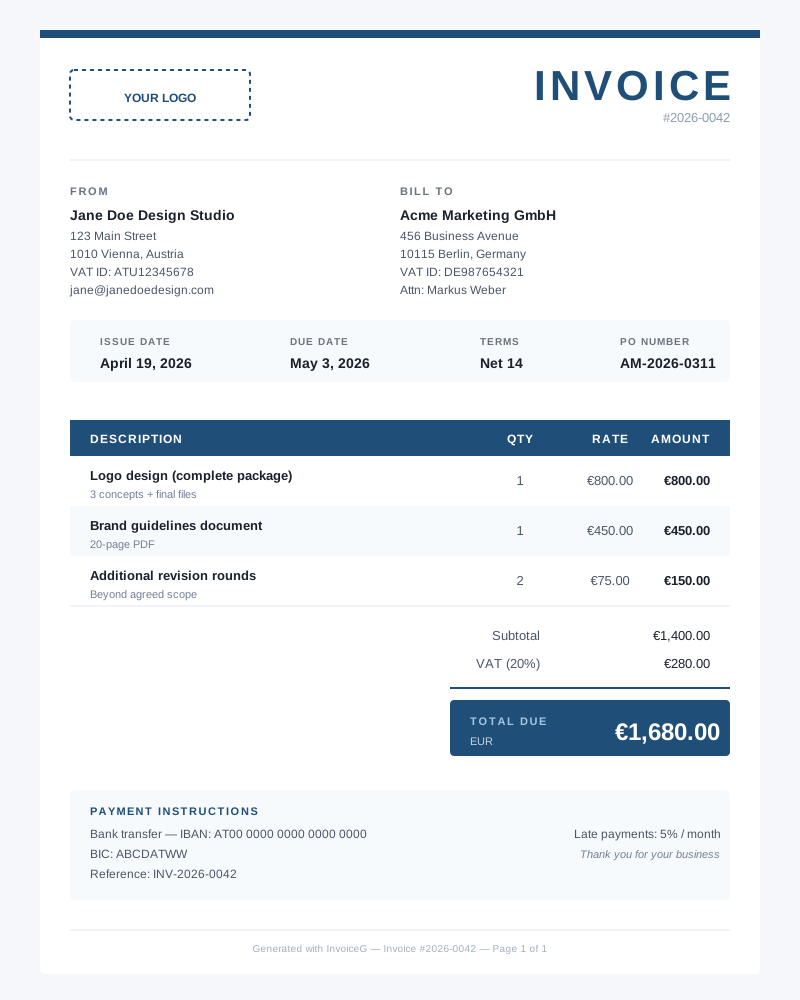
Every element serves a purpose: the unique invoice number enables tracking, the specific descriptions prevent disputes, the tax ID satisfies regulatory requirements, and the payment instructions remove friction for the client.
Want to use this exact template?
We’ve prepared a free Excel invoice template that mirrors this example, with all formulas pre-built for subtotals, discounts, tax, and grand totals. Just fill in your details, save as PDF, and send.
Download the free Excel invoice template
The template includes two sheets: the invoice itself and a step-by-step instructions page. All calculations are automatic, so you only enter rates and quantities.
Types of Invoices
Not all invoices are the same. Knowing which type to issue in which situation is part of professional invoicing.
Standard invoice — the default. Issued after work is completed or goods are delivered, requesting payment by a specified date.
Proforma invoice — a preliminary invoice sent before work begins or goods are shipped. It outlines expected costs but is not a demand for payment. Common in international trade and for customs purposes.
Recurring invoice — issued on a regular schedule (weekly, monthly, quarterly) for ongoing services like retainers, subscriptions, or memberships. Automation tools are almost essential for managing these.
Final invoice — closes out a multi-invoice project. References earlier deposits or milestone invoices and requests the remaining balance.
Credit note (credit invoice) — issued to reduce the amount a client owes, typically due to a return, overcharge, or correction. Legally it’s a “negative invoice.”
Debit note — the opposite: issued to increase the amount owed, usually when additional charges apply after the original invoice.
Interim invoice — used to bill portions of a large project in stages rather than waiting for full completion.
Past-due invoice — not a new type technically, but a resend of an unpaid invoice with updated terms or late fees applied.
Commercial invoice — used in international trade and required by customs. Includes origin country, harmonized system (HS) codes, and terms of shipment.
Self-billing invoice — issued by the buyer on behalf of the seller, under a formal agreement. Common in certain B2B contexts like publishing royalties.
Choosing the right type prevents confusion and ensures proper accounting treatment on both sides.
Invoicing Requirements by Jurisdiction
Invoicing rules vary significantly by country. While the core components are universal, specific legal requirements differ — and getting them wrong can cost you money or your tax deductions.
United States
The U.S. has no federal invoice format requirement, but invoices must support tax filings. Key points:
- Sales tax is state-level; rates and rules vary by state
- Freelancers and contractors must issue invoices that align with Form 1099 reporting
- No VAT system — sales tax is collected only on the final sale, not throughout the chain
- Retention requirement: typically 3–7 years for tax records (IRS generally recommends at least 3 years)
United Kingdom
Post-Brexit, the UK operates its own VAT system. A full VAT invoice must include:
- A unique, sequential invoice number
- Your business name, address, and VAT registration number
- The customer’s name and address
- Supply date and invoice date
- Description of goods or services, rate per item, and quantity
- Total amount excluding VAT, VAT rate, VAT amount, and total including VAT
- Retention: 6 years
European Union
EU VAT rules are harmonized but with country-specific variations. Standard VAT invoice requirements include:
- Sequential invoice number
- Supplier and customer VAT numbers (for B2B)
- Reverse charge mechanism reference for cross-border B2B
- Currency (usually local, but EUR acceptable)
- Retention: 5–10 years depending on member state
A major change is coming: e-invoicing is becoming mandatory across several EU member states. In Belgium, from January 1, 2026, all VAT-registered businesses must issue and receive structured electronic invoices for domestic B2B transactions via the Peppol network, and paper or unstructured PDF invoices are no longer legally sufficient. Poland, France, Germany, and Spain are following with phased rollouts through 2026–2028. More detail on this in the next section.
Canada
Canada has GST (federal) plus PST or HST depending on province. Invoice requirements include:
- Your business name and GST/HST number
- Invoice date and a unique number
- Buyer’s name
- Description, quantity, and price of each item
- Applicable tax with rate
- Retention: 6 years
Australia
Tax invoices in Australia require:
- The words “Tax Invoice” clearly displayed
- Seller’s identity and ABN
- Invoice date
- Brief description of items sold
- GST amount (or statement that total includes GST)
- For invoices above AUD 1,000, the buyer’s identity or ABN is also required
- Retention: 5 years
General advice
If you invoice internationally, research the rules for both your country and your client’s country. When in doubt, consult a local accountant — a 30-minute conversation can save you thousands in fines or lost deductions.
E-Invoicing and Modern Compliance (2026 and Beyond)
The invoicing landscape is undergoing its biggest transformation in decades. Governments across the EU, Latin America, and parts of Asia are moving from optional electronic invoices to mandatory structured e-invoicing — a fundamentally different concept than simply emailing a PDF.
What e-invoicing actually means
Sending a PDF by email is not e-invoicing. True e-invoicing is the end-to-end digital exchange of invoices between supplier and buyer systems in a structured, machine-readable format — typically XML-based — that can be automatically validated, processed, and archived without manual re-entry.
Key formats and standards:
- Peppol BIS Billing 3.0 — the dominant European network and format
- EN 16931 — the European standard defining core invoice data
- UBL 2.1 — Universal Business Language XML format
- Factur-X / ZUGFeRD — hybrid PDF+XML formats (France, Germany)
- FA(3) — Poland’s proprietary XML schema
- FatturaPA — Italy’s format (in use since 2019)
The driving force: ViDA
The EU’s VAT in the Digital Age (ViDA) package, adopted on March 11, 2025, is pushing all 27 member states toward harmonized real-time reporting and structured e-invoicing by 2030–2035. The goal: close the estimated €93 billion VAT gap through near-instantaneous visibility of transactions.
Who is affected in 2026
- Belgium: Mandatory B2B e-invoicing via Peppol from January 1, 2026 — no paper or PDF invoices between VAT-registered businesses
- Poland: Mandatory B2B e-invoicing through the KSeF platform, rolling out in February–April 2026 based on company turnover
- France: Receiving e-invoices becomes mandatory for all businesses in September 2026; issuing mandatory for large and mid-size companies at the same time, SMEs by September 2027
- Germany: Businesses must be able to receive structured e-invoices since January 2025; issuing becomes mandatory for larger businesses in 2027 and all B2B by 2028
- Spain: Veri*factu real-time reporting for corporate taxpayers from January 1, 2026; full B2B mandate expected 2027–2028
What this means for beginners
If you operate in or sell to any of these markets, you cannot rely on PDFs alone. You need either:
- A Peppol-connected invoicing platform (most modern SaaS tools include this)
- Integration with a national e-invoicing platform (for France, Poland, Italy)
- A service provider that handles compliance on your behalf
The good news: modern invoicing tools handle the format conversion, network transmission, and archiving automatically. What was once an enterprise-only concern is now accessible to freelancers and SMEs through cloud solutions.
Penalties for non-compliance
Fines for failing to comply are real and increasing. In Belgium, for example, penalties escalate with repeated non-compliance and include administrative fines for businesses lacking technical capability to send or receive structured invoices. Spain’s mandate carries fines up to €10,000 per non-compliant invoice. Ignoring these rules is not an option for active businesses.
International Invoicing
Billing clients across borders adds layers of complexity. Get these right and you’ll avoid weeks of delays and tax headaches.
Currency considerations
- Decide currency upfront — your local, client’s local, or a neutral currency like USD or EUR
- Fix the exchange rate in the contract, or state that invoicing uses the rate on the issue date
- Include currency code, not just the symbol — “$1,000” is ambiguous (USD? CAD? AUD?)
- Use multi-currency invoicing tools for clients paying in different currencies
Cross-border VAT and reverse charge
For B2B services within the EU, the reverse charge mechanism usually applies: the seller doesn’t charge VAT, and the buyer accounts for it in their own country. This requires:
- A note on the invoice: “VAT reverse charge applies — Article 196 Directive 2006/112/EC” (or equivalent)
- Both parties’ VAT numbers on the invoice
- Verification of the client’s VAT number via the EU VIES system
For B2C or sales outside the EU, rules change significantly. Sales of digital services to EU consumers are subject to OSS (One Stop Shop) VAT registration.
Payment methods for international clients
- Bank transfer (SWIFT) — universal but slow (2–5 days) and carries fees
- SEPA — fast and cheap within the Eurozone
- Wise, Revolut Business — favorable exchange rates and lower fees for cross-border transfers
- PayPal, Stripe — convenient but take 2.9–4.4% plus currency conversion markup
- Payoneer — popular for freelancers working with U.S. and global clients
Language and localization
If your client doesn’t operate in your native language, consider a bilingual invoice (your language + English, or client’s language + English). It reduces processing friction and increases goodwill.
Withholding tax
Some countries require the buyer to withhold a percentage of payment for tax purposes before paying the supplier. Common in parts of Latin America, Asia, and Africa. Research your client’s country rules or ask for a tax treaty exemption certificate if one applies.
Common Invoicing Mistakes (and How to Avoid Them)
Every experienced invoicer has made these mistakes. The goal is to learn them early.
Missing or incorrect information. A wrong address, missing VAT number, or misspelled client name can cause payment delays of weeks. Fix: always verify client details in writing before the first invoice.
Incorrect calculations. Math errors — especially with tax — force reissuance and erode client trust. Fix: use invoicing software or a spreadsheet with formulas; never calculate manually on final invoices.
Unclear or vague payment terms. “Pay when you can” is not a term. Fix: always specify an exact due date and accepted payment methods.
Late invoicing. Waiting weeks to send an invoice after work is completed signals disorganization and delays your cash flow. Fix: invoice within 24–48 hours of completion, or on a fixed schedule.
No follow-up system. Sending once and hoping for the best is not a strategy. Fix: schedule reminders at T-3 days, due date, T+3 days, and T+7 days.
Duplicate or missing invoice numbers. Breaks your accounting and can trigger tax audit issues. Fix: use sequential numbering and never manually assign numbers.
Sending editable formats. Word docs and spreadsheets can be altered, creating disputes. Fix: always send PDFs.
Ignoring tax rules. Missing VAT, applying the wrong rate, or forgetting reverse-charge mechanisms for cross-border B2B can result in fines. Fix: research your jurisdiction’s rules or use software that handles them.
No record keeping. Deleted emails and lost files become tax nightmares. Fix: maintain a dedicated cloud folder with every invoice ever sent.
Inconsistent branding and format. Invoices that look different every time appear unprofessional and harder to process. Fix: use a consistent template.
Not preparing for e-invoicing mandates. Assuming PDFs will always be acceptable is increasingly risky. Fix: if you operate in the EU or sell to EU clients, evaluate Peppol-compatible tools now.
Best Invoicing Practices
Beyond avoiding mistakes, certain practices elevate invoicing from adequate to excellent.
- Clarity over brevity — detailed line items prevent disputes far more than short ones
- Consistency — same template, same numbering, same payment terms across all invoices
- Speed — invoice immediately after completion; speed of invoicing correlates directly with speed of payment
- Automation — remove manual steps wherever possible, especially for recurring clients
- Communication — always pair the invoice with a short, human message
- Professionalism — branded, clean, error-free invoices get paid faster
- Documentation — keep contracts, scope documents, and email threads linked to each invoice
- Transparency — if rates change, mention it; if expenses are included, itemize them
- Future-readiness — choose tools that support e-invoicing standards even if not yet mandatory for you
Invoicing Habits for Long-Term Success
Systems beat willpower. These habits, practiced weekly, compound into financial stability.
Batch invoicing. Pick one day each week for invoicing. Consolidating the task saves mental energy and ensures nothing slips.
Weekly payment review. Spend 15 minutes every Monday scanning what’s paid, pending, and overdue. Early detection of late payers is worth hours of chasing later.
Monthly reconciliation. Match invoices against bank deposits once a month. Catch discrepancies while memory is fresh.
Quarterly cash flow review. Zoom out. Which clients pay on time? Which drag? Are your terms working? Adjust accordingly.
Continuous template refinement. Every time something causes confusion on an invoice, update the template. After a year, your template is battle-tested.
Client communication rhythm. Send end-of-month statements for clients with multiple invoices. Proactive communication reduces friction.
Annual system audit. Once a year, review your entire invoicing setup — tools, templates, workflows — and upgrade what isn’t working.
Tools That Simplify Invoicing
Manual invoicing works for a handful of clients. Beyond that, tools become essential.
Spreadsheets (Excel, Google Sheets) — the zero-cost starting point. Fine for 1–5 invoices a month, but quickly limits you on tracking, automation, and professionalism.
Dedicated invoicing software — tools like InvoiceG and similar platforms handle invoice generation, tax calculation, sending, tracking, and reminders automatically. They’re particularly valuable for recurring invoices and multi-currency work.
Accounting software — QuickBooks, Xero, FreshBooks, and similar combine invoicing with full bookkeeping. Best for businesses that need integrated financial reporting.
Payment processors — Stripe, PayPal, Wise, and others integrate with invoicing tools to enable one-click payment from the invoice itself, dramatically reducing payment friction.
Peppol-connected platforms — for businesses affected by EU e-invoicing mandates, connection to the Peppol network is essential. Many modern invoicing tools include this built-in.
Document storage — Google Drive, Dropbox, or cloud-based accounting tools for archiving.
The right tool depends on volume, complexity, and budget. Most beginners are well-served by a dedicated invoicing platform that scales with them and handles compliance automatically.
Advanced Beginner Tips
Once the fundamentals are solid, these moves separate professionals from amateurs.
Shorten your payment terms. Net 30 is tradition, not law. Many freelancers successfully use Net 7 or Net 14. Faster terms equal faster cash flow.
Require deposits on large projects. 30–50% upfront isn’t aggressive — it’s standard. It protects you and filters out non-serious clients.
Offer small discounts for early payment. “2% off if paid within 7 days” can meaningfully accelerate cash flow.
Charge late fees (and enforce them). Stated late fees reduce late payments, even when rarely collected.
Automate recurring clients. Every hour spent manually creating repeat invoices is an hour wasted.
Use payment links, not bank details alone. The easier you make it to pay, the faster you get paid.
Send invoices early in the week. Mondays and Tuesdays have higher open and action rates than Fridays.
Track your invoicing KPIs. Average days to payment, percentage paid on time, and percentage of invoices disputed are all worth monitoring.
Plan for international clients. Currency, language, tax treatment, and payment methods all need consideration before the first invoice.
Build a scalable pricing structure. Flat rates, hourly rates, retainers, and milestone-based pricing each have different invoicing implications. Choose deliberately.
Consider invoice financing. For established businesses, factoring or invoice financing can bridge cash flow gaps — though at a cost worth weighing carefully.
FAQ
What should an invoice include?
At minimum: your business details, client details, a unique invoice number, issue and due dates, itemized line items, subtotal, tax, total due, and payment instructions. Specific jurisdictions may require additional fields like tax IDs or legal notices.
How do beginners create their first invoice?
Start with a simple template (spreadsheet or free invoicing tool), fill in the core components listed above, verify all math, save as PDF, and send by email with a short professional message. Repeat the process identically for consistency.
What is the invoicing process?
The end-to-end lifecycle: work completion → invoice creation → sending → waiting period → follow-ups → payment received → record keeping. Each stage should have a defined action on your part.
When should invoices be sent?
As soon as possible after work is completed or goods are delivered — ideally within 24–48 hours. For ongoing work, follow a fixed schedule (weekly, bi-weekly, monthly).
What are the most common invoicing mistakes?
Missing information, calculation errors, vague payment terms, late invoicing, duplicate invoice numbers, and lack of follow-ups. Each is preventable with a checklist and a consistent template.
How long should I keep invoices on file?
Most jurisdictions require 5–10 years of retention for tax purposes. When in doubt, check local regulations — but defaulting to 10 years of secure cloud storage is a safe approach.
What’s the difference between an invoice and a receipt?
An invoice requests payment; a receipt confirms payment has been made. You issue an invoice before payment and a receipt after.
Do I need to charge tax on my invoices?
It depends on your jurisdiction, your registration status, your client’s location, and the nature of the transaction. VAT-registered businesses in the EU, for instance, must charge VAT with specific rules for cross-border B2B. Research your local requirements or consult an accountant.
How do I handle unpaid invoices?
Follow a structured escalation: friendly reminder at T+1 day overdue, firmer message at T+7 days, formal notice at T+14 days, and collection action or legal steps beyond that. Most invoices resolve in the first two stages.
Can I send an invoice before completing work?
Yes — this is either a proforma invoice (non-binding estimate) or a deposit invoice (requesting upfront payment). Both are standard practice, especially for larger projects.
What is e-invoicing and do I need it?
E-invoicing is the structured electronic exchange of invoice data between supplier and buyer systems in a machine-readable format — not simply emailing a PDF. It’s becoming mandatory in several EU countries in 2026–2028. If you operate in or sell to those markets, you’ll need a compliant solution.
What’s the difference between an invoice and a proforma invoice?
A standard invoice is a legal demand for payment after work is completed. A proforma invoice is a preliminary document showing expected costs, issued before the transaction, and is not a binding request for payment.
Do I need an invoice if I’m a sole proprietor or freelancer?
Yes. Even if you’re not incorporated, you should issue invoices for tax, record-keeping, and client clarity. In most jurisdictions, invoices are required for any taxable business activity.
Invoicing essentials aren’t glamorous, but they’re the difference between a business that gets paid reliably and one that constantly chases money. The good news: none of it is complicated once you understand the full picture. You know what an invoice must contain, how the process works from start to finish, which types exist, which rules apply in your jurisdiction, how the e-invoicing revolution is reshaping compliance, which mistakes to avoid, and which habits compound into long-term stability.
The real secret isn’t any single technique — it’s consistency. A clean template, a reliable workflow, a weekly review, and a professional tone applied to every invoice you send. Start with the fundamentals, layer in the checklist, build the habits, and gradually introduce tools as your volume grows.
Everything else is refinement. The foundations you’ve just learned will serve you for the entire life of your business — whether you’re invoicing your first client next week or your thousandth next year.